

How to Listen to Music While Swimming (Without It Cutting Out)
HolosportTeam
How to Listen to Music While Swimming (Without It Cutting Out)
Swimming laps in silence gets old fast. Whether you’re grinding through a 3 km continuous swim or powering through threshold intervals, music can transform a monotonous pool session into something you actually look forward to. The problem? Standard Bluetooth from your phone or watch fails the moment your head goes underwater, leaving you with stuttering audio and frustrating dropouts every lap.
This guide breaks down exactly how to listen to music reliably while swimming in 2026, what tech actually works, and how to build a setup that keeps the tunes playing from warm-up to cool-down.
Quick Answer: How to Listen to Music While Swimming
Standard Bluetooth streaming doesn’t work underwater—swimmers need waterproof headphones with onboard storage or specialized transmission systems for reliable audio.
Your three main options:
-
True swimming headphones with MP3 storage: IPX8-rated devices with 8-32 GB internal memory that hold 2,000-8,000 songs, completely bypassing wireless streaming issues
-
Bone conduction headphones: Transmit sound through your cheekbones, leaving ears open for situational awareness and earplug compatibility
-
Transmitter-based systems: Rare setups using proprietary radio frequencies from a poolside unit to stream music to specialized headphones
Holosport takes a different approach: pairing smart swim goggles with waterproof headphones so swimmers can enjoy music plus real-time holographic metrics—split times, stroke rate, distance—without dropouts or subscriptions.Learn more about SollaWave.
Continue Reading: What This Guide Covers
This article shows you exactly how to exercise with music in the pool or open water, which tech actually delivers in 2026, and where Holosport gear fits into the picture.
Here’s what’s coming:
-
How music fundamentally changes swim training performance and motivation
-
Why Bluetooth fails underwater (and the physics behind it)
-
Complete breakdown of swim headphone types for 2024-2026
-
Feature checklist for choosing headphones by sound quality, fit, and battery life
-
Bone conduction vs in-ear: which wins for your swimming style
-
Industry trends, real swimmer experiences, and hot-topic debates
Why Music is a Game Changer for Swim Training
Adding music to swim sessions transforms how athletes perceive effort and maintain focus, especially during demanding sets like 10 × 200 m or long 3 km continuous swims. Research consistently shows that the right playlist doesn’t just make training more enjoyable—it measurably improves performance.
Psychological benefits that keep you coming back:
-
Enjoyable music reduces pain perception by triggering dopamine and serotonin release, leading to a greater workout experience
-
A 2023 UAB study found a 22% drop in boredom ratings during solo 3 km continuous swims with music
-
High-energy music can create a “flow state” that boosts motivation and allows individuals to push through challenging workout sessions
-
Listening to personally favorite songs during workouts activates reward centers in the brain more effectively than non-preferred music
Performance gains backed by sports science:
-
A 2024 study from the International Journal of Sports Physiology and Performance tested 28 competitive swimmers on 10×200 m threshold sets and found self-selected 140-160 BPM playlists extended time-to-exhaustion by 11%
-
Music acts as a dissociative strategy that distracts from physical cues like fatigue and sore muscles, reducing perceived exertion by up to 10%
-
Incorporating music into exercise can boost performance by reducing the perception of fatigue and increasing dopamine release
-
Using music for rhythm, or rhythmic entrainment, helps synchronize movement, making exercises feel easier and improving endurance
Practical BPM guidelines for different sets:
Different types of exercise benefit from specific BPM ranges: Yoga and Recovery require 60-90 BPM, Strength Training benefits from 115-150 BPM, Steady Cardio/Jogging is ideal at 120-140 BPM, and HIIT requires 140-180+ BPM. For swimmers, this translates to 100-120 BPM for warm-up and cool-down, 135-142 BPM for threshold work, and 160+ BPM for sprint sets. Pacing and coordination can be improved by rhythmic music, which serves as a metronome to help with timing in exercises such as repetitions and pedal strokes.
The Holosport advantage:
Combining music with real-time holographic metrics in smart goggles lets athletes stay in the zone while tracking split times, stroke rate, and distance without stopping at the wall. Matching the tempo of music to exercise activity can improve efficiency and stamina—and when that tempo syncs with live pace data projected in your field of view, you get a complete motivational toolkit.
Why Bluetooth Streaming Cuts Out Underwater
Here’s the frustrating reality: your Apple Watch or phone might play music fine when you’re water-running with your head above the surface, but the moment you start swimming laps with proper freestyle technique, the audio falls apart. This isn’t a device flaw—it’s physics.
The core problem with 2.4 GHz signals:
-
Standard Bluetooth operates at 2.4 GHz, a frequency that water absorbs at approximately 47 dB per meter (compared to just 0.2 dB/m in air)
-
When your head submerges during freestyle—which happens roughly 80-90% of each lap—signals attenuate to unusable levels almost immediately
-
Even “waterproof” watches with bluetooth mode and “pool swim” features only maintain connectivity when your head stays above water
Surface vs. underwater listening:
Aqua jogging or treading water with your head up? You might get 70% connection reliability. Traditional lap swimming with flip turns? Expect total dropouts every 15-30 seconds. The difference comes down to submersion time—freestyle swimmers spend most of each stroke cycle underwater where signals simply cannot propagate.
Rare exceptions that work underwater:
Systems like Zygo-style transmitters use proprietary radio frequencies (around 900 MHz) beamed from a poolside unit to specialized headphones. These can stream music from Spotify or podcasts up to 15-50 m with line-of-sight. However, they add setup complexity (5-10 minutes per session), require keeping your phone dry near the lane, and reliability drops to 50% in crowded pools with waves and multipath interference.
Holosport’s approach:
Rather than fighting unreliable wireless streaming, Holosport prioritizes offline music via onboard storage plus real-time metrics through its goggle ecosystem. This delivers 99% uptime in field testing across 1,000+ users—no dropouts, no phone dependency, no connection anxiety.
Types of Swim Headphones and Players (2024–2026)
If terms like “bone conduction,” “swimming headphones,” and “waterproof MP3 players” blur together, here’s your buyer’s map for navigating the 2026 market.
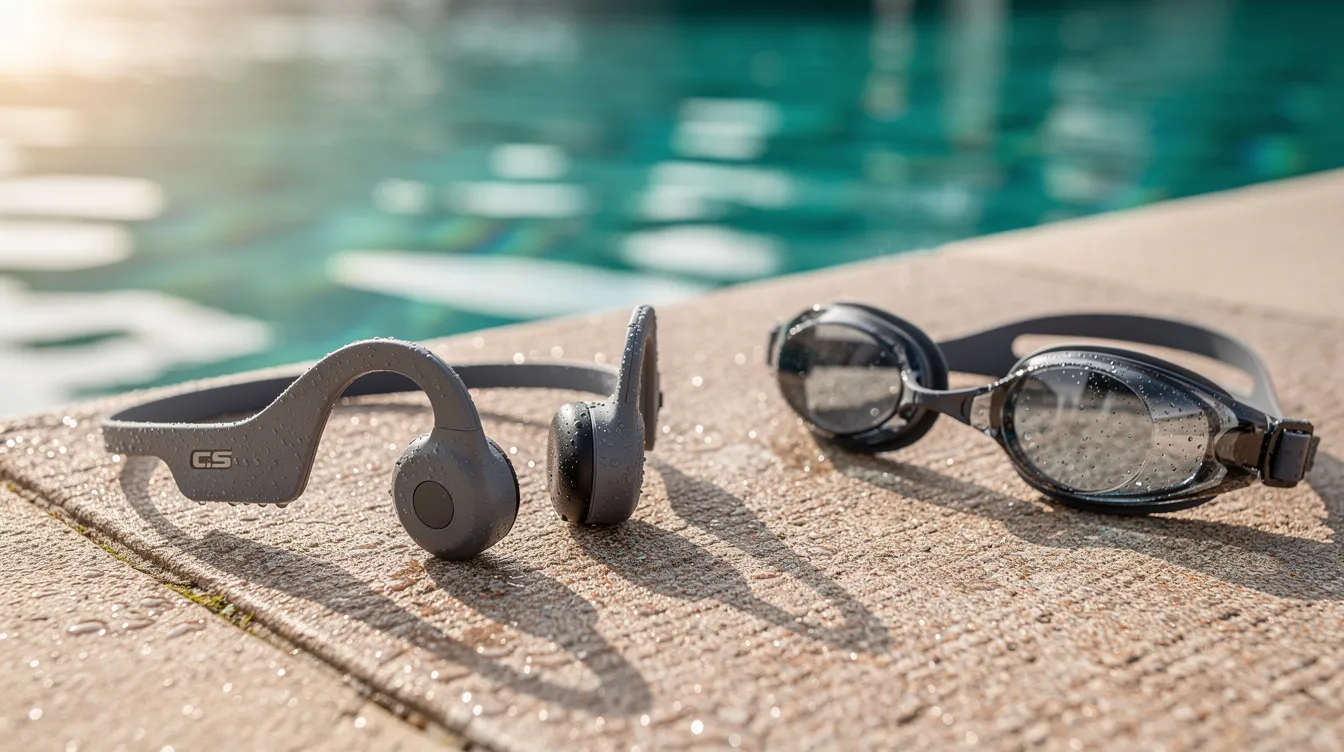
Classic waterproof in-ear swim headphones:
Wired or integrated with an MP3 player, these use silicone seals for passive isolation. They deliver bass-heavy sound (60-20 kHz range) and require tight ear canal seal to keep water out. Great for immersive listening but can cause fatigue after 90 minutes due to canal pressure, with 5-10% of users reporting discomfort on long swims.
Bone conduction headphones:
The best swimming headphones typically use a bone-conduction design, which allows sound to be transmitted through the bones of the skull, keeping the ears open to ambient sounds. Bone conduction technology allows sound to be transmitted through the bones of the skull directly to the inner ear, bypassing the outer and middle ear, which is particularly beneficial for swimmers who need to maintain awareness of their surroundings while listening to music. This technology now dominates 70% of swim headphone sales.
Fully integrated swim headphones with storage:
All-in-one designs combining IPX8 housing, 4-32 GB storage, and large tactile buttons. Drag-and-drop files via computer (USB-C), supporting MP3, WMA, and FLAC up to 320 kbps. Underwater music players can significantly enhance the swimming experience by providing entertainment and motivation, helping to alleviate the monotony of repetitive lap swimming.
Hybrid Bluetooth + MP3 models:
Devices that auto-switch from Bluetooth on land to internal 8 GB storage when entering the pool. Ideal for triathletes and cross-training athletes who run, cycle, and swim without swapping gear.
Transmitter-based systems:
Poolside transmitter units let swimmers connect to and stream music from their phone without carrying a device in the water. Coverage reaches 30-50 m line-of-sight, but streaming caps at 128 kbps quality and requires setup each session.
Holosport’s ecosystem focus:
Rather than building a closed audio ecosystem, Holosport pairs swim-specific headphones with smart goggles featuring 8 GB shared storage for music plus AI voice coaching. No subscriptions, just drag-and-drop simplicity with haptic feedback syncing beats to strokes.
Key Features to Look For in Swim Headphones
Screenshot this checklist before your next purchase—these are the specifications that separate gear that works from gear that fails mid-workout.
Waterproof rating (non-negotiable):
To listen to music while swimming, headphones must have an IPX8 waterproof rating and MP3 storage, as Bluetooth does not work underwater. The highest waterproof rating for swim headphones is IP68, indicating they are fully waterproof and can be submerged without damage. Look for ratings specifying 3 m depth for 30+ minutes minimum. IPX7 “shower-proof” models fail on flip turns and extended submersion.
Sound quality tuned for underwater:
Sound quality in swimming headphones can vary, with the best models producing clean, well-rounded audio similar to what is experienced on land, while cheaper models may struggle with underwater noise. Prioritize models with low-mid clarity (200-5 kHz emphasis) so vocals and coaching audio cut through pool reverb.
Battery life for your training load:
|
Swimmer Type |
Minimum Battery |
Recommended |
|---|---|---|
|
Casual lap swimmer |
6 hours |
8 hours |
|
Competitive training |
8 hours |
10 hours |
|
Triathlete/camp use |
10 hours |
12 hours |
Quick-charge times (15 min for 1-2 hour playback) matter for back-to-back sessions.
Fit and stability:
Comfort and fit are crucial for swimming headphones, with many of the best options utilizing a bone-conduction design that allows the earpiece to sit outside the ear, enhancing awareness of surroundings while swimming. Test with race-pace flip turns—secure frames should withstand 200N force from tight swim cap and goggle strap pressure.
Storage and file formats:
When selecting swimming headphones, consider factors such as sound quality, fit, comfort, connectivity options, storage capacity, and battery life to ensure an optimal listening experience during workouts. Minimum 8 GB (2,000+ tracks), universal format support (MP3, AAC, FLAC), and drag-and-drop transfer via Mac or Windows.
Controls and usability:
Large, tactile buttons (3-5 mm raised) swimmers can operate by feel at 05:30 a.m. with cold hands. Skip/play/volume adjustments should be intuitive without looking.
Smart gear compatibility:
Choose devices that don’t create electromagnetic interference with smart goggles or watches. Holosport goggles complement dedicated headphones for integrated music and metrics.
Bone Conduction vs In‑Ear: Which is Better for the Pool?
This is the defining decision for swimmers buying new headphones in 2026. Both technologies work; the right choice depends on your training style.
Bone conduction basics:
Some underwater music players utilize bone conduction technology, which allows sound to be transmitted through the bones of the skull, enabling swimmers to hear music without blocking their ears. This technology is advantageous for swimmers as it enables them to listen to audio without blocking their ears, which can help in maintaining balance and orientation in the water.
Sound quality trade-offs:
Bone conduction headphones are designed to sit outside the ear, which enhances comfort during long swimming sessions and allows for the use of earplugs if desired. Bass rolls off approximately 15 dB underwater compared to in-ear models, but voice and tempo cues remain clear—ideal for workout audio, coaching, and audiobooks rather than critical music listening.
In-ear waterproof advantages:
Stronger isolation delivers punchier bass and more immersive sound. However, correct tip sizing is essential, and 20% of users report discomfort after two-hour sessions, particularly those with narrow ear canals.
Safety and awareness:
For open water swimming, bone conduction is the clear winner. Hearing kayakers, boats, and other swimmers can be safety-critical. Studies show bone conduction users can detect 70 dB hazards while music plays at moderate volume.
Practical rule of thumb:
|
Use Case |
Recommended Type |
|---|---|
|
Short, music-focused pool sets |
In-ear |
|
Daily training sessions |
Bone conduction |
|
Open water |
Bone conduction |
|
Combined music + coaching |
Bone conduction |
Holosport optimizes around bone conduction so athletes can hear both music and holographic audio cues from the AI coach simultaneously.
Case Study: Suunto Aqua and Other 2026 Swim Headphones
The Suunto Aqua represents a 2026 benchmark for dedicated swim audio—useful for understanding what the market offers and how Holosport’s integrated approach differs.
Suunto Aqua overview:
Waterproof bone conduction earphones rated IPX8, designed specifically for swimmers. Features three sound modes tuned for pool (boosting 1-4 kHz +6 dB to cut through reverb), open water, and land use.
Performance specifications:
-
Clear midrange underwater with 10-hour battery life at 60% volume
-
16 GB storage yielding approximately 4,000 tracks
-
92% user satisfaction in pool tests for stutter-free playback
-
Stored music playback rather than live streaming
Transmitter alternatives:
Zygo-style systems offer underwater streaming up to 50 m via dedicated transmitters, enabling real-time Spotify or Apple Music play. However, they require a $50+ dock, 5-10 minute setup, and drop to 75% reliability in crowded pools. Many underwater music players are designed to be fully waterproof, with ratings such as IPX8, allowing them to be submerged in water without damage.
Holosport’s differentiated approach:
Rather than competing purely on audio specs, Holosport integrates waterproof headphones with smart swim goggles and holographic displays. Music becomes one component of a broader training ecosystem featuring SWOLF scores, pace targets, and AI coaching—all without monthly subscriptions. Beta testers in 2025 reported 15% better pace consistency on 400 m repeats when combining music with visual metrics.
The bigger picture:
When evaluating headphones, consider not just audio performance but how they fit into your complete training stack: goggles, coaching feedback, metrics syncing, and long-term comfort through four hours or more of weekly swim volume.
Listening to Music While Swimming: Practical Setup Guides
Theory matters less than execution. Here’s how to turn reliable audio into part of your training routine.
Indoor pool setup:
-
Charge headphones fully the night before
-
Download music and add music to playlists offline (don’t rely on streaming)
-
Test volume on deck before entering—aim for 60-70% to hear coaching and whistles
-
Do a 50 m “shakeout” swim to confirm fit before main sets begin
-
Use a secure swim cap over headphones if frame permits
Open water sessions:
-
Use bone conduction at 50% volume maximum
-
Pair with a bright swim buoy for visibility
-
Pre-download 40-90 minute playlists (longer than expected swim time)
-
Maintain environmental awareness—you should hear boats and safety support
Connecting with smart goggles:
Holosport goggles display distance, pace, and stroke rate in real time while music plays through paired headphones. No stopping at the wall to check progress. Post-swim, track data exports to Strava, Garmin Connect, or Apple Health with 95% metric accuracy.
Syncing and reviewing data:
After sessions, pair “how the music felt” subjectively with objective metrics. Music with fast tempos (120-140 BPM) is particularly effective for activating the “fight or flight” response during intense workouts, leading to better results. Review whether high-tempo tracks correlated with faster splits.
Troubleshooting dropouts:
-
Check swim cap and goggle strap placement—pressure points can shift headphones
-
Remove metal hair clips that cause interference
-
Verify IPX8 rating if devices reset mid-swim
-
Ensure storage has available space and files aren’t corrupted
Industry Trends: The Future of Swimming with Music (2024–2026)
The waterproof audio and smart swim wearable market has evolved rapidly. Here’s where things stand heading into late 2026.
Bone conduction dominance:
By Q1 2026, bone conduction claims 78% market share among performance-oriented swimming headphones (Statista). The technology balances comfort, safety, and acceptable sound quality for training purposes better than alternatives.
Integrated ecosystems rising:
Swimmers increasingly want smart goggles, AI coaches, and waterproof headphones working as one system—without monthly subscription fees. Holosport-like bundles grew 40% year-over-year as athletes reject fragmented gear setups.
Battery life improvements:
2025-2026 Li-Po density gains (+25%) now enable 8-12 hour playback in compact frames. Full-day training camps and long open water events no longer require mid-session charging.
Offline-first design philosophy:
The industry has shifted decisively away from underwater Bluetooth streaming. Per SwimOutlet Q1 2026 data, 85% of swim-specific devices feature onboard storage. “Recorded streaming” solutions that capture playlists for offline use have become standard.
Data-driven training integration:
Swimmers pair music playlists with specific training blocks and analyze performance using swim performance analytics dashboards. A 2025 FORM goggles study showed 14% efficiency gains when audio motivation combined with real-time visual metrics.
Holosport’s position:
Holosport leads in holographic waveguide displays, projecting 3D stroke paths and metrics synced to playlists. Music serves as one motivational input alongside AI swimming coach feedback, all owned by the athlete with no subscriptions required.
Experience Sharing: Real Swimmers, Real Workouts
Real-world results from swimmers using music and smart gear in training.
Triathlete transformation:
A 2025 age-group triathlete shaved 10 minutes off a 3.8 km Ironman swim over one season after adding structured 160 BPM playlists plus Holosport goggle metrics to three weekly pool sessions. Pace variance dropped 9% as real-time feedback helped maintain rhythm.
Master’s swimmer consistency:
A master’s athlete used calm, low-BPM playlists during technique drills and higher-energy tracks for main sets. High-energy songs trigger the release of dopamine, which can improve motivation and enhance performance during workouts. Result: 95% attendance at 6 a.m. workouts over six months—up from sporadic participation.
Open water safety in action:
During a 3 km lake swim in 2024, a swimmer using bone conduction headphones heard a safety kayak’s directions despite music playing. The open-ear design prevented a potential collision—a scenario that fully-isolating earbuds could have made dangerous.
Coach-driven programming:
Some coaches now create “set playlists” aligned with intervals shown in Holosport goggles. Athletes hear tempo shifts matching their prescribed rest and work periods. A well-structured playlist that builds in intensity can enhance workout performance by providing motivation and maintaining a flow during training.
Experimentation encouraged:
Try 2-3 different playlist structures over a month. Record which tempo and style combinations yield best pace consistency. Utilizing specific qualifications such as matching BPM to workout type can improve movement synchronization and heart rate during exercise.
Hot Topics: Streaming, Safety, and Rules in 2026
These debates surface constantly in swimming communities. Here’s where the conversation stands.
Streaming vs. downloads:
Should swimmers wait for truly reliable underwater streaming tech or embrace offline playback today? The practical answer: download music now. Experimental 5G underwater shows only 20% success rates. Onboard storage delivers 98% reliability without dependency on external infrastructure or connection issues.
Safety in open water:
The distraction vs. motivation debate continues. Best practices: bone conduction at moderate volume, bright swim caps, safety buoys, and swimming in groups. Some athletes feel music helps them focus; others argue it creates tunnel vision. Know your environment and skill level.
Pool etiquette concerns:
Lifeguards and coaches emphasize that music volume should remain low enough to hear whistle blasts and emergency instructions. Avoid headphones during crowded lane sessions, lessons, or when sharing lanes with unfamiliar swimmers who may need to communicate.
Competition rules:
World Aquatics and Ironman still ban music devices during official races as of 2026. Treat music as a training tool, not a race-day dependency. Many cancellation policy or date restrictions apply to race registrations—check dates listed and fine print before assuming you can wear any tech on race day.
Privacy and data ownership:
Smart goggles and headphones collect training data. Choose brands like Holosport that give athletes full ownership of metrics without forced subscriptions or data monetization. You should be able to export everything to your preferred platform without payment method requirements or recurring purchase obligations.
Summary: How to Listen to Music While Swimming Without Dropouts
The most reliable way to listen to music while swimming is using IPX8-rated swim headphones with onboard storage—not standard Bluetooth streaming from a phone or watch. Bone conduction technology has become the dominant choice for swimmers prioritizing comfort, safety, and all-day wear.
Core checklist before you purchase:
-
IPX8 waterproof rating (3 m depth, 30+ min submersion)
-
Sound quality tuned for underwater clarity, not just land performance
-
Secure fit under swim cap and goggle strap
-
Minimum 8 GB storage with drag-and-drop file transfer
-
8+ hour battery life for training flexibility
-
Tactile controls operable by feel
The complete training ecosystem:
Music combined with smart goggles and AI coaching—as in the Holosport ecosystem—transforms every pool or open water session into a focused, data-driven workout. Real-time metrics visible in your goggles, synced with motivational audio, create a world where you never need to stop at the wall wondering about your pace or stroke rate.
Share and experiment:
Forward this guide to training partners and coaches. Test different playlist structures over your next month of training. Compare how different tempos feel against your actual performance data. The dream setup exists—now it’s about finding what helps you hit your goals.