

Are AR Swim Goggles Safe for Your Eyes? Here’s What Our Vision Health Test Shows
TeamHoloSport
Are AR Swim Goggles Safe for Your Eyes? Here’s What Our Vision Health Test Shows
If you have ever wondered whether an augmented reality display belongs inside swim goggles, the real question is not just “Do the goggles work?” It is “Can the display help without adding visual strain?” Holosport built its smart swim goggles around that concern: show the right swim data at the right moment, while keeping the swimmer’s view calm, readable and focused.
Introduction: From Fighter Jet HUDs to Swim Goggles
A heads up display, sometimes written as a head up display, began as aviation technology: flight information placed in front of a pilot so they could monitor speed, altitude and targeting without looking down. Specialized HUD systems are still used in aviation and driving to monitor speed, altitude, and mapping without diverting attention from the road or runway. By the 1980s, military and commercial systems were evolving toward enhanced flight vision systems, synthetic vision systems and more advanced optics that kept critical information in the line of sight.
That same idea now appears in smart glasses, smart goggles and sports wearables. Heads-Up Display (HUD) glasses are transparent smart eyewear that overlays 2D digital information onto the real-world line of sight. HUD glasses keep users’ heads up and hands free by showing notifications, GPS directions, and real-time translations in front of their eyes. For swimmers, the value is even clearer: you cannot easily check a watch mid-stroke, especially in open water.
Holosport applies the same HUD principle to the swimming world. Instead of asking swimmers to stop at the wall, glance at an apple watch, or guess pace by feel, Holosport puts real time metrics directly into the swimmer’s line of sight. This article explains how hud display glasses work underwater, what our visual health test shows, how Holosport compares with FORM and FINIS, and what to look for before you choose a pair.
What Are HUD Display Glasses and Smart Goggles?
HUD display glasses are eyewear with a built-in micro-display that projects information into the user’s field of vision. A microscopic projector or display, typically using Micro-LED or Micro-OLED technology, is built into the frame of HUD glasses to generate digital text or images. HUD glasses utilize a tiny, highly synchronized optical system within the frame, and waveguide optics inside HUD glasses use Total Internal Reflection (TIR) to direct light through the lens without losing clarity.
General-purpose smart glasses often focus on notifications, navigation or everyday productivity. HUD glasses typically pair with smartphones via Bluetooth to pull notifications and data. Some HUD glasses project images to a single eye, known as monocular display, to save weight and battery, while others project to both eyes, known as binocular display, to prevent visual fatigue. When selecting HUD smart glasses, key features to consider include binocular technology, brightness, comfort, weight, and intuitive input mechanisms. HUD glasses can wash out under direct sunlight, often requiring tinted or photochromic lenses.
Water-specific smart swim goggles are different. They need sealed electronics, waterproof buttons, anti fog coating, clear lenses, motion sensors, a processor, battery life for long swim sessions and comfort around the eye socket. Smart swim goggles often feature augmented reality (AR) displays that provide real-time training data directly in the swimmer’s line of sight, allowing for a more immersive swimming experience.
In Holosport goggles, the HUD is designed as a floating, semi-transparent overlay near the edge of vision rather than a block in the center. The goal is to preserve peripheral vision and forward awareness while showing pace, split time, distance, stroke rate, heart rate, calories burned and rest intervals. Holosport focuses on AR/HUD for swim training and endurance training, not general-purpose browsing or messaging.
Are AR Swim Goggles and HUD Displays Safe for Your Eyes?
Are AR swim goggles safe for your eyes? That is the first question many swimmers ask the first time they imagine wearing an augmented reality display underwater. The concern is reasonable. Any near-eye display can create discomfort if brightness, contrast, focal distance or alignment are poorly designed.
Holosport’s HUD system is built to reduce that risk during typical 30–90 minute swim sessions. The display uses controlled brightness, short focal distance design principles, readable contrast and simple data layouts so most swimmers can check information quickly without staring at the display. Smart swim goggles are designed to minimize distractions by providing essential metrics such as time, distance, and pace directly in the swimmer’s field of vision, helping maintain rhythm and focus during workouts.
Holosport Smart Sports Glasses have completed a professional visual health evaluation based on T/MIA 0001-2022, “Methods for Testing and Evaluating the Impact of XR Devices on Visual Health.” This standard focuses on how XR and AR devices may affect visual fatigue, binocular balance, accommodation, convergence and comfort during extended use. Research on optical see-through displays has also highlighted why these factors matter, especially when virtual information and the real world compete for attention; studies indexed by PubMed discuss visual comfort and perceptual limits in optical see-through head-mounted displays.
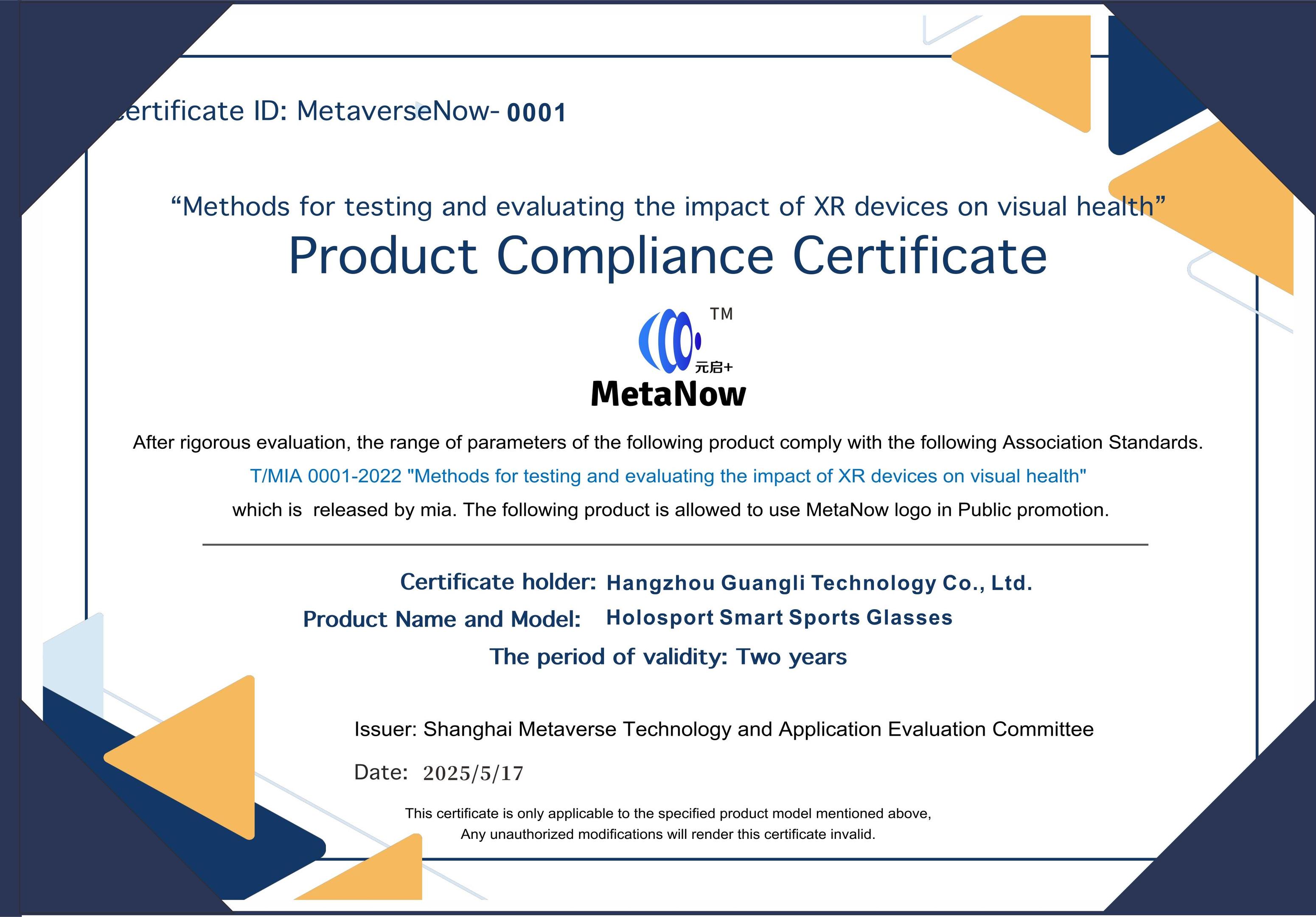
Certification details are as follows:
-
Certificate Holder: Hangzhou Guangli Technology Co., Ltd.
-
Certified Product: Holosport Smart Sports Glasses
-
Standard: T/MIA 0001-2022
-
Evaluation Focus: Visual health impact of XR/AR devices
-
Issuing Organization: Shanghai Metaverse Technology and Application Evaluation Committee
-
Validity Period: 2 Years
-
Certificate ID: MetaverseNow-0001
After rigorous testing and evaluation, the product was certified as compliant with the association standard and approved for public promotion use under the MetaNow certification system. For swimmers, that means Holosport’s AR swim display is designed for regular training use, so you can focus on real-time pace, stroke feedback, heart rate and AR-assisted training without worrying about unnecessary visual strain from the HUD system.
How HUD Display Glasses Work in the Water
Underwater HUD technology starts with a micro-display that sends light toward a transparent optical element inside the lens. The optics create the heads up display effect, so the swimmer sees numbers and cues as if they are floating in front of the eye. The hardware must be waterproof, stable during a push off, and readable when the head rotates for breathing.
The swim intelligence comes from motion sensors such as accelerometers and gyroscopes. These sensors track head movement, stroke patterns, flip turns, rest intervals and lap timing in the pool. Smart swim goggles provide real-time data on speed, distance, and stroke count, allowing swimmers to adjust their technique and pacing without interrupting their rhythm.
Holosport goggles can pair with optional external devices, such as a GPS watch or HandPlus heart rate monitor, to add open water route, distance and precise effort data to the HUD display. Many smart swim goggles include heart rate monitoring capabilities, allowing swimmers to track their heart rate in real time without the need for chest straps, enhancing workout efficiency and safety.
Data refresh timing matters. Pace may update every length or at set intervals, while heart rate can update every few seconds. That rhythm avoids a distracting flood of numbers. The goggles also adapt to different environments with brightness control, waterproof sealing and anti fog lens treatments. After training, rinse with fresh water, use gentle soap when needed, and avoid rubbing the anti fog layer aggressively.
Competitor designs show why placement matters. FORM goggles provide a larger heads-up display, while FINIS goggles feature a smaller, less intrusive display that is tucked away, allowing for a less distracting swimming experience. Holosport aims to keep the central field as unobstructed as possible while keeping the data easy to see.
Key Features to Look For in Swim HUD Glasses
Not every pair of smart goggles is built for the same swimmer. Before you buy, look beyond the feature list and think about comfort, clarity and how the goggles will fit your actual training.
-
Comfort and fit: Look for soft silicone gaskets, multiple nose bridges from S–XL, a dual-strap design and low weight around the eyes. Secure fit matters for flip turns, open water chop and the first few swims when you are still adjusting.
-
Display design: The best hud display is readable in low-light pools and bright sun, with clear font size and stable positioning. It should not force you to turn your head or stare away from the lane.
-
Battery life: Premium smart swim models often deliver around 10–14 hours, enough for several pool sessions or multiple open water swims before recharging. Always check battery life before a long dive into open water.
-
Swim metrics: Core metrics include lap count, distance, pace per 100 m or yd, stroke rate, SWOLF, heart rate, calories burned and rest timing. Smart swim goggles provide real-time feedback by displaying metrics such as speed, distance, and stroke count directly in the swimmer’s line of sight, allowing them to monitor their performance without interruption.
-
Heart rate monitoring: Some systems use integrated sensors, while others connect to a heart rate monitor. Holosport supports strap-free heart rate options and in-lens heart rate zones so swimmers can control effort without guessing.
-
Durability and anti fog: Look for anti-scratch protection, strong anti fog performance and care instructions that make sense. A claimed 1,000-wipe anti fog test is useful only if the goggles remain clear in real swim workouts.
-
App ecosystem: A swim app should let you sync swim data, review sets, view heart rate zones and track progress. The integration of smart swim goggles with mobile apps allows users to sync their swim data, analyze performance metrics, and receive personalized feedback to improve their swimming technique. Holosport is built to connect with apple health and other training platforms without a required subscription.
-
Price and value: Market pricing can range from entry-level devices near $99 to advanced models above $350. The Smart Swim 2 Goggles retail for $279, with no subscription required to access the core features. Premium features for the Smart Swim 2 Goggles require a subscription of $9.99 per month after a free one-month trial. Holosport’s smart swim goggles do not require any ongoing subscription fees, providing all features from day one without paywalls.
Holosport’s Approach to HUD Swim Goggles
Holosport is a sport technology brand focused on AR, AI and real time feedback in motion. Our product ecosystem includes smart swim goggles, underwater audio goggles, heart rate monitors and connected accessories for swimmers, triathletes and endurance athletes.
The guiding philosophy is simple: useful data should appear at the moment it can change your swim. If you only see pace after the set, you have lost the chance to adjust. Holoswim smart swim goggles use proprietary holographic optics and motion algorithms to surface key data without making swimmers stop, look down or break rhythm.
Holosport differentiates itself from competitors like FORM and FINIS by offering real-time, in-motion intelligence without requiring a subscription, focusing on a seamless user experience during swimming. Core features work from day one, so training plans, pace feedback, heart rate zones and post-swim analysis are not locked behind paywalls.
The Holoswim series targets both performance-driven swimmers and recreational users, emphasizing ease of use and comfort, while competitors like FORM and FINIS focus more on detailed metrics and advanced training features. That means a triathlete can use structured data, while a casual swimmer can simply wear the goggles, track distance and enjoy a smoother session.
Comparing Leading HUD Smart Goggles (FORM, FINIS, Holosport)
FORM helped create broad awareness for smart swim technology with the original form swim product in 2019. Today, Smart Swim 2 and Pro models offer an AR display, heart rate integration, guided workouts, HeadCoach features and app-based analysis. The form swim app and form app are useful references for swimmers who want structured coaching, although some advanced features use a subscription model.
FINIS takes a different approach with a left-side HUD unit, multiple nose bridges, a dual strap and a removable module that can be placed into new FINIS frames. Its display is smaller and tucked away, which some swimmers find less intrusive. If you compare 2 goggles from different brands, display placement is often the first thing you notice.
Holosport’s approach is to combine underwater clarity, visual-health-tested HUD design, AR/AI swim intelligence and no subscription paywall. The integration of augmented reality in smart swim goggles allows swimmers to receive immediate feedback on their performance, enhancing their training efficiency and technique. The integration of augmented reality (AR) in smart swim goggles allows swimmers to receive immediate feedback on their technique and performance, enhancing their training experience without the need to stop and check data.
The biggest practical difference is how the data feels in motion. A larger central display can be easier to read but may require adaptation. A smaller tucked-away display can feel calmer but may need a glance. Holosport aims for a balanced layout that keeps the center open while making the numbers available at the right moment.
HUD Glasses for Open Water Swimming
Open water swimming is where HUD technology becomes more than convenient. There are no lane lines, no pace clock and no wall to reset your focus. Waves, glare, currents and navigation all increase the mental load.

Modern smart goggles can pair with a GPS watch to show distance, pace and heading in real time. Features similar to FORM’s SwimStraight show how a virtual compass can help swimmers hold a straighter line. Holosport uses GPS data from compatible devices to provide heading, route and distance feedback during an open water swim.
This can improve safety and confidence. Instead of sighting constantly, swimmers can check direction and effort quickly. Seeing time in water, distance covered and approximate calories burned can reduce anxiety during longer crossings or triathlon starts.
Heart rate is especially useful outside the pool. When excitement makes you push too hard early, real-time effort feedback can help you settle. Real-time feedback from smart swim goggles can help swimmers identify areas for improvement in their technique, such as head position and stroke efficiency, which can lead to better performance over time.
Before you start, confirm the GPS watch connection, check battery life, adjust straps and make sure the goggles seal well. In rough water, a small fit issue can become a big distraction.
Training, Coaching and AR Feedback Inside the Lens
AR coaching turns raw data into useful guidance. Instead of finishing a set and discovering you faded, the display can show target pace, stroke cues, interval timing and recovery information while the swim is still happening.
Competitor systems such as HeadCoach from FORM show the direction of the category: algorithm-driven coaching across a session. Holosport’s vision is more focused on simple cues that protect rhythm and technique, not filling the lens with every number possible.
There is a difference between guided workout libraries and “swim your way” feedback. Guided workouts can create structured sets for a club swimmer or triathlete. Lightweight feedback can help recreational swimmers stay motivated with time, distance and effort.
Using smart swim goggles can help swimmers avoid common injuries by promoting better form and technique through real-time monitoring and feedback during workouts. For example, if stroke rate climbs while pace drops, that may suggest wasted effort. If head position changes with fatigue, technique cues can help the swimmer reset before poor mechanics become habit.
As AI and biometric sensing improve, training could become more personal. Future systems may adapt training plans based on recent load, sleep, recovery and heart rate response. The key is restraint: the best swim coach inside a lens should guide, not distract.
Who Are HUD Swim Goggles For (and Who Might Not Need Them)?
HUD swim goggles are best for lap swimmers, triathletes and endurance athletes who care about pacing, heart rate, stroke feedback and progress over time. If your training depends on intervals, splits and consistent effort, in-lens data can make sessions more precise.
Performance swimmers benefit from seeing whether they are holding pace before the set falls apart. Triathletes benefit from open water navigation and effort control. Recreational swimmers can keep things simpler by tracking distance, time, heart rate and calories burned without turning every swim into a data project.
Absolute beginners may not need AR data immediately. If you are still building water confidence, regular goggles and basic technique work may matter more than metrics. Once you can swim comfortably, HUD feedback becomes more useful.
Holosport is especially suited to swimmers who want modern augmented reality, real time feedback and connected training without ongoing subscription obligations. If you dislike wrist devices, chest straps or stopping to check data, a head-based display can feel more natural.
Future Directions for HUD Display Glasses in Sport
HUD display glasses are moving beyond aircraft and cars into running, cycling, skiing and multi-sport training. As optics get lighter and sensors improve, athletes will expect data to appear where attention already is: forward.
Future systems may add richer navigation, more accurate heart rate, recovery insights and adaptive coaching. A runner may see pacing cues on smart glasses. A cyclist may see safe navigation. A swimmer may see route guidance, effort zones and technique prompts inside the same goggles used for daily training.
Swimming is an ideal first testbed because the pain point is obvious. Swimmers cannot comfortably check devices mid-stroke, yet pace, distance and technique matter every minute. That is exactly where a no-distraction HUD can help.
Holosport will continue to focus on eye safety, visual health testing, firmware updates and app improvements that make the experience better over time. If you are ready to experience HUD display glasses built specifically for water, explore Holosport smart swim goggles and connected gear designed to help you train with clearer data, better focus and fewer interruptions.